Tampilkan postingan dengan label Kesetimbangan Benda Tegar. Tampilkan semua postingan

Jumat, 02 Mei 2014

Latihan Soal Fisika-Gelombang

1.    Guitar string guitar strings to resonate with the other when the two strings are the same ... 
a. Voltage. 
b. Length. 
c. Frequency. 
d. Broad cross-section. 

Discussion: 
Resonance is an event participated pulsate an object due to the influence of other objects the same frequency. 

2.    Propagation of sound waves in the air have a pattern ... 
a. Long and short wave. 
b. Density and renggangan 
c. Peak and base 
d. Mountains and valleys 

Discussion: 
The sound is one example of longitudinal waves. The characteristics of longitudinal waves: 
- Waves that have a direction parallel resistance (direction) to the direction of vibration. 
- Consists of renggangan and density. 
- These waves can occur in solid, liquid or gas but not in a vacuum. 
- Not having amplitude. 
Thus, sound waves propagate with renggangan pattern and density. 

3.    An insect prey can hear sound frequencies in the range 15Hz. The sound on these frequencies including ... 
a. Supersonic 
b. Infrasound 
c. Untrasonic 
d. Audiosonic 

Discussion: 
- Supersonic: planes that have a high speed. 
- Infrasound: sounds that have a frequency of less than 20Hz 
- Ultrasound: sound that has a frequency of more than 20.000Hz 
- Audiosonic: sounds that have frequencies between 20Hz to 20.000Hz.sound that can be heard by humans. 

4.    Apollo aircraft noise can not be heard on the moon the astronauts on the moon because of ... 
a. 
No steam. 
b. Vacuum. 
c. Temperature is too high. 
d. Pressure is very low. 
Discussion: 

Month vacuum so that no particles that deliver sound. Aircraft noise on the moon can not be heard at all the astronauts. 

5.    Pitch a string greater if ... 
a. The length of wire and string enlarged section area stringed minimized. 
b. Voltage and string minimized. 
c. 
Voltage and wire cross-sectional area is enlarged. 
d. Long strings of string tension is reduced and enlarged. 

Discussion: 

Pitch four factors influenced strings. 
Pitch / frequency of the larger wire if: 
- The length of wire strings shortened / reduced. 
- Wire cross-sectional area is minimized. 
- Style tense wire string enlarged. 
- The density of strings is minimized.

6.    A source emits with intensity 10-5 watt/m2. If the intensity threshold value 10-12 watt/m2, determine the level of intensity of the sound!

Discussion :

To calculate the intensity of a sound level using the following equation :
Description: https://blogger.googleusercontent.com/img/b/R29vZ2xl/AVvXsEjXo3EHT-0S3F-dsUsn0kcoa_T7FasMbEOLQSPmso8ba_7V6c-kJfrCb2IAI_dSQrMn28jpXZvSSrNnoxftCNHaDLo4Lj-BWkKlZCQIHkcI8EZtm6tSWE2fLydVyiZWt-4s6jZ1iOOKkKNT/s1600/p12bunyi1r.png
of the data obtained about :
Description: https://blogger.googleusercontent.com/img/b/R29vZ2xl/AVvXsEin9j0bWwKB1Ls3imaD6f6dzEQEiM-0HpgbEFaw0FtddFwMD69yKGEd0Y5ZmUT5zDXfrNqmj5_S5PV5HcQA9IFfthyphenhyphenp70ZeTN7De2Ji5YiLBf0UcgGZp1FwlVIKsF6UhyTiejIXhkZL_aRV/s1600/p12bunyi1.png

7.       A child is at a distance of 100 m from a source of sound power 12.56 watts. Determine the level of intensity of the sound is heard the child if Π is 3.14 and the hearing threshold intensity I0 = 10-12 watt/m2!

Discussion :

To determine the intensity of the sound level using the following equation :
The sound intensity level
 Description: https://blogger.googleusercontent.com/img/b/R29vZ2xl/AVvXsEjXo3EHT-0S3F-dsUsn0kcoa_T7FasMbEOLQSPmso8ba_7V6c-kJfrCb2IAI_dSQrMn28jpXZvSSrNnoxftCNHaDLo4Lj-BWkKlZCQIHkcI8EZtm6tSWE2fLydVyiZWt-4s6jZ1iOOKkKNT/s1600/p12bunyi1r.png
Sound Intensity
Description: https://blogger.googleusercontent.com/img/b/R29vZ2xl/AVvXsEjZ3koWRQu1874Qhcy1lDNJDRyXx-NUDrtLBNbHnhRanlumv1zZ42bG5oBcouIwLDzAvuV2eLmX55Zmo73J_bhaOzzbAcpgiARJfv2rrQCmVYRv3BKaYeMUw9xll4CABdeigNgGsuf0VkHb/s1600/p12bunyi2r2.png
Where P is power in watts, and A is the area in units of m2, assuming the sound spreads evenly to form an area in the form of a ball so that A = 4 Πr2, where r is the radius of the ball or equal to the distance of the child from the sound source.
So:
 Description: https://blogger.googleusercontent.com/img/b/R29vZ2xl/AVvXsEh-u6GRFEiUT6gptQQnzoLgAw7ChTxtYvSYnWr4kyMTiAgA-9QrA60rTzuImK4LTTI9YPASYCM-sMX8UPRhojT3v54vTOp-430hsSVJinaQTe4I-7Rk1M9PhWVWwbipfqOYT_KDDdlB3I50/s1600/p12bunyi2a.png
Description: https://blogger.googleusercontent.com/img/b/R29vZ2xl/AVvXsEhEEpSR_h7Gi0Lg-mglMPO_lTYmuTMu1KEdCcCq9e3_fbzJpaNEFD70zReVM24uMIv_fPfjCsYRwO-b9M20LhVa6zy2rHRqrOTBn5drK4EoH2ap51dJixILVWu5OJrf17tdyYDtxn21zinS/s1600/p12bunyi2b.png

8.       A firebomb exploded at a distance of 20 meters from a child. Description: https://blogger.googleusercontent.com/img/b/R29vZ2xl/AVvXsEihRvOI0e9IT2laRc6ls4UyBo866mq1NXkga_W5jGqI-kihZQXg-1_QeXWjrUZqaZk0hmez1GVtPV3zdSRwnzTAuSprkk2AX4dQF4UbGJLC5pOD8yV0yoY0vBS0KLRPsEQKcY95m0Yi_FsB/s1600/bommolotv.png
If the child is heard a blast with the intensity level of 120 dB, determine the level of intensity is heard another child who was at a distance of 180 m from the first child!

Discussion :

To determine the intensity level of a sound source heard from two different places used the following equation:
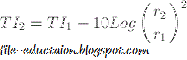
 Description: https://blogger.googleusercontent.com/img/b/R29vZ2xl/AVvXsEi_xmKPkmwBFTVrD7V_TvagQfM-nh7BWLzaZE5mwXXYQGT3hgWexTc6-ziYZEinjtzKL8jcM9LXxEuFYJZ0Qc5V0cnBGLBv0Ysm4xvxh1jn1hV_dnuqtUtYoJnxV1WpzYAWNtsnZ1DGhkF-/s1600/p12bunyi3rrev.gif
r1 is the distance to the first child of the sound source (20 m) and r2 is the distance of the second of the sound source (180 +20 = 200 m)
Description: https://blogger.googleusercontent.com/img/b/R29vZ2xl/AVvXsEhftT06z6PH_WfRLHKdIcxWu39TmHrocwXX6DK3kPw2oP1HXmiPuu8ZcyJLZtHecE4r_Fd1enaFJNnDJ8fH-eQYFprWIDZRfIqHjjLqYNKWE4rHjdrTj1_dWab2Cp4vRkAGXweNmyOBV-Nn/s1600/p12bunyi3.png

9.       A factory has 100 identical machines. If a machine has a sound intensity level of 70 dB, determine the value of the intensity level of the sound is heard when all the machines in the factory turned on simultaneously!

Discussion :

To determine the intensity of the sound by Taraf many identical sources using the following equation:
Description: https://blogger.googleusercontent.com/img/b/R29vZ2xl/AVvXsEhXL-MfQ0buuhUxLt4qqYKviWHEcTpBGpw5oHlFVTGXIyFpFVoh0qmGX8qcftPTf6uPheZAYuFLJ5URxGnQqLOoOiFwyVKM5fQXf_saZsRC1oEX3ZY4uqYhFpOKmodtq4s3e8PvAV8xZTVT/s1600/p12bunyi4r.png
 where TI1 is IT a source of sound and n is the number of sound sources. So that :
Description: https://blogger.googleusercontent.com/img/b/R29vZ2xl/AVvXsEhC9IzGtmQlTCTXlrpIwEzz91aVWJs1VG_xsJv2lZWt4P42L8XxGbQbqYp6qViRUif6i8vfTbIvwO3868Tv86HqqJbE2TBKS5zGFDI06KWcdToNTe2s2DtM8tXLAc16HHhrze1C8nnpilMU/s1600/p12bunyi4.png

10.   Determine the value of comparative intensity of a sound source from two places, namely A, which is 4 m from the source and from B within 9 m from the source!

Discussion :
The intensity of a sound source from two different places:
Description: https://blogger.googleusercontent.com/img/b/R29vZ2xl/AVvXsEgonaAghYRE3HdIp6lay1ToDGQxnvopAldiTX3YtFo5WblWnP7tiF4vyvnWyjVPsoVNDfFUT1_RhBDIuOdZRC6p7oinc2hbjyMy_IGVl08GhHUHMOAjkxX3lCLV_J2ik3RBa_8tRpbtFQfM/s1600/p12bunyi5.gif

11. A spectator at the race car heard the sound (roar of the cars) were different, when a car approaching and away. Average race car emits 800 Hz. If the speed of sound in air 340 ms-1 speed and 20 ms-1, the frequency of which is heard when the car is approaching ....
A. 805 Hz
B. 810 Hz
C. 815 Hz
D. 850 Hz
E. 875 Hz

Discussion :

The application of the Doppler effect, the listener in a stationary position means Vp = ZERO, sources close to the listener is a sign for negative Vs.
Description: https://blogger.googleusercontent.com/img/b/R29vZ2xl/AVvXsEhjayzg4O_qfDdl_duVafAfM8pMlB6RDyHmCTN4T_WahVZFCLHhpFtQwD2gcjzuvT_XAqvFcnMZyyaAbvyCeEyH-KzfwDW6xHQ02UZqVW2dbWYKCbF4xKDYJSdrajtX2pHwDZowcExYV3OS/s400/p12bunyi6.gif
12. A 1 kHz sound source moves directly toward the listener a break at a pace of 0.9 times the speed of sound. Frequency in kHz is received ....
A. 10.0
B. 1.9
C. 1.1
D. 0.5
E. 0.1

Discussion :

Description: https://blogger.googleusercontent.com/img/b/R29vZ2xl/AVvXsEgJ717mB-gJ_eXc6u8s_EtJTdcnnkLIDRDn47qG620cLjloq5Ph0kMn3aKicHZtAD8-FmUDHZcX6lkQV2rkwt3gHBCxyEGmkYoGIdNwiYDwoXdhskG6ackwFJRmPWPfEnfjENdeStjDv-Oh/s400/p12bunyi7.gif
13. Piano string length of 0.5 m and a mass of 10-2 kg stretched 200 N, then the basic piano tone is frequency ....
A. 100 Hz
B. 200 Hz
C. 400 Hz
D. 600 Hz
E. 800 Hz

Discussion :

Wave velocity in the string is:
Description: https://blogger.googleusercontent.com/img/b/R29vZ2xl/AVvXsEg3dQTFajJBtBUlLHAADKP5Px_AQPJSsWB9hrJtFZSrJ5cRHiVSbEpYRdFm4_Eu3b31qPJWoyWc57CLDWaJCWYoR6XUtFVCEwqf9Gg8yYQhvSZsH43m5g6kjQ97kKnt-0olFUwbpapBf4YK/s400/p12bunyi8a.gif
Base notes on the strings occurs when:
Description: http://fisikastudycenter.files.wordpress.com/2010/12/p12bunyi8b.gif
Frequency string:
Description: https://blogger.googleusercontent.com/img/b/R29vZ2xl/AVvXsEj0Lfd5hmBzQMr9TvWQisFc1dDJRT47R3LdbQ1-qnu0cjLxzjPsWYG4YEyHKOUYtzynHXCnv9qMDafQgXnbytADlE6ZzyQdnCzeNxbQzuAVd62Phs1d108nWt5ASHWO7u95Y8i1Eamo_5n1/s400/p12bunyi8c.gif
Formula:
Description: http://fisikastudycenter.files.wordpress.com/2010/12/p12bunyi8brev.gif
14. An open organ pipe produces tones at a frequency of 150 Hz. Determine the frequency of the second tone of the pipe organ!

Discussion :

Comparison of frequency tones, the first tone, the tone on the second and so on of a closed organ pipe is:
F0: F1: F2: F3: ..... = 1: 3: 5: 7: .....
If you take the comparison between f2 and f0 obtained:
Description: https://blogger.googleusercontent.com/img/b/R29vZ2xl/AVvXsEhuRhHLVPsqQVoi1X8wraEI7Iyq3_xGpo7Qhydh5cNYR_IB1o1fBL6wJyVrJ6ZiqLYgynZ8UJLE-IXekH_Nh2sjjLyspiJ0cNWyMMYbNzR2fAKSJHHt0YcCLkq62HVVIFjsJutVGZy19Qgi/s400/p12bunyi9b.gif

15. Rows of railroad car that is pulled by a locomotive leaving the station Tanjung Karang moving at a pace of 36 km / h. At that time, an officer at the station blew the whistle with a frequency 1700 Hz. If the speed of propagation of sound waves in the air 340 ms-1, find the frequency whistle is heard by an observer in the train.

Discussion:

Given: vp = 36 km / hr = 10ms-1 ; vs = 340 ms-1; fs = 1700 Hz
So the frequency of the whistle is heard by an observer on the train at 1650 Hz.

16. The noise of a typewriter equal to 70 dB. How dB noise due to 100 pieces an office typewriter?

Discussion:

Consider the intensity of the typewriter = I1
the intensity of 100 typewriters I1 = I2 = 100,

Find additional noise due to 100 typewriter:
∆TI = 10 log I2/I1 = 10 log 100 = 20 dB I1/I1
So noise is 100 typewriters: TI1 + TI2 = ∆TI = 90 Db

17. Sound waves from a source having the propagation of 340 m / s. If the frequency of sound waves is 500 Hz, determine the wavelength!

Discussion :

Data about:
ν = 340 m / s
f = 500 Hz
λ = ?

Relations wavelength, wave propagation and frequency:

λ = ν / f
λ = 340/500
λ = 0.68 m

18. A child hear the sound that has a wavelength of 5 meters. If the propagation of sound in air is 340 m / s, find:
a) the frequency of the sound source
b) the period of the sound source

Discussion :

Data about:
ν = 340 m / s
λ = 5 m
f = .......... Hz

Relations wavelength, wave propagation and frequency:
f = ν / λ
f = 340/5
f = 68 Hz

19. A ship of a sea depth gauge using the sound device. Beep fired into the bottom waters and 5 seconds later reflected sound arriving back at the ship. If the propagation of sound in water is 1500 m / s, determine the depth of the waters!

Discussion :

Determine the distance of two points (depth) with the reflection of sound:
S = (ν x t) / 2
S = (1500 x 5) / 2
S = 3750 meters

20. When the weather was cloudy a child heard the thunder of 1.5 seconds after the visible lightning. If the propagation of sound in air is 320 m / s, determine the distance of the source of the child's thunder!

Discussion :

Determine the distance of two points with no sound reflections:
S = ν x t
S = 320 x 1.5
S = 480 m

 21. Sound waves with a frequency of 5 kHz propagating in air with a temperature of 30 ° C. If the propagation of sound in air at 0 ° C is 330 m / s, find:
a) the propagation of sound
b) the length of the sound wave

Discussion :

The difference in the propagation of sound due to the differences / changes in air temperature:
ν = ν0 + 0.6 t
ν = 330 + (0.6 x 30)
ν = 348 m / s

22. Sound with a wavelength of 1.5 m has a propagation speed of 330 m / s. Can sound be heard by the human ear normal?

Discussion :

Looking frequency first:
f = ν / λ
f = 330 / 1.5
f = 220 Hz
Sounds with frequencies between 20 and 20,000 Hz audiosonik considered, can be heard by humans.
Learn more:
infrasound: sound frequencies less than 20 Hz
ultrasonic: sound frequencies greater than 20000 Hz

23. A first resonance occurs when the air column tube tube length of 15 cm. Define:
a) the wavelength of the sound
b) the length of the air column during the second resonance
c) the length of the air column during the third resonasi
d) the length of the air column resonance during the fourth
e) the frequency of the sound, if the propagation of sound is 340 m / s

Discussion  :

a) the wavelength of the sound
The first resonance → L = (1/4) x λ
15 = (1/4) x λ
λ = 4 x 15
λ = 60 cm

b) the length of the air column during the second resonance
The second resonance → L = (3/4) x λ
L = (3/4) x 60 cm
L = 45 cm

c) the length of the air column during the third resonasi
The third resonance → L = (5/4) x λ
L = (5/4) x 60 cm
L = 75 cm

d) the length of the air column resonance during the fourth
Fourth resonance → L = (7/4) x λ
L = (7/4) x 60 cm
L = 105 cm

e) the frequency of the sound, if the propagation of sound is 339 m / s
λ = 60 cm = 0.6 meters
ν = 339 m / s
f = ?

f = ν / λ
f = 339 / 0.6
f = 565 Hz

24. Determine the ratio of the frequency of which is owned by a string A string length of 100 cm and a length of 50 cm B if the two strings are made of the same material

Discussion :

fA / fB = LB / LA
fA / fB = 50/100
fA: fB = 1: 2

25. Strings I and II strings are the same length. If the cross-section area stringed I was three times the size of the string section II, specify:
a) comparison of the frequency of the strings I and II strings, consider the strings have the same voltage
b) the frequency of the strings II if the frequency of the strings I was 500 Hz

Discussion:

a) f1 / f2 = A2 / A1
f1 / f2 = A2 / 3A2
f1: f2 = 1: 3

b) f1: f2 = 1: 3
f2 = 3 x f1
f2 = 3 x 500
f2 = 1500 Hz

Makalah Fisika-Kesetimbangan Benda Tegar

Makalah Fisika
“Kesetimbangan Benda Tegar”


Disusun Oleh :

Fadhilatus Shoimah
XI IPA 7 / 08


SMA N 1 Rembang
2011 / 201
KATA PENGANTAR

            Puji syukur kehadirat Allah SWT Dzat penguasa alam semesta yang telah memberikan taufiq, rahmat, hidayah serta inayahnya sehingga saya dapat beraktivitas untuk menyusun dan menyelesaikan makalah yang berjudul “ Keseimbangan Benda Tegar “ ini. Walaupun banyak isi dari rangkuman karya ilmiah ini saya kutip langsung dari sumber. Tapi saya berharap karya ilmiah ini dapat membantu dan menambah wawasan saudara-saudari yang ingin lebih memahami atau mengetahui sekilas  tentang “ Keseimbangan Benda Tegar “.
            Penyusunan makalah ini bertujuan untuk memenuhi tugas fisika yang diberikan oleh Bapak guru Sukarno.
            Makalah ini berisi informasi tentang “ Kesetimbangan Benda Tegar “. Yang kami harapkan pembaca dapat mengertahui berbagai aspek yang berhubungan dengan keseimbangan benda tegar yang akan kami bahas ini.
            Kami menyadari bahwa makalah ini masih jauh dari sempurna, oleh karena itu kritik dan saran dari semua pihak yang bersifat membangun selalu kami harapkan demi kesempurnaan makalah ini di masa yang akan datang.
Akhir kata, kami sampaikan terima kasih kepada semua pihak yang telah berperan serta dalam penyusunan makalah ini dari awal sampai akhir. Semoga Tuhan Yang Maha Esa senantiasa meridhoi segala usaha kita. Amin.
Dan akhirnya semoga makalah ini bermanfaat bagi kita semua terutama bagi pembaca. Terima kasih,

                                                                                                Rembang, 20 Mei 2012
                                                                                                            Penulis


DAFTAR ISI

Halaman Judul……………………………………………………………………………………1
Kata Pengantar………………………………………………………………………………….2
Daftar Isi…………………………………………………………………………………………3
Pendahuluan………………………………………………………………………………………4
Pembahasan
1.      Kesetimbangan Benda Tegar…………………………………………………6
2.      Titik Berat……………………………………………………………………11
Kesimpulan……………………………………………………………………………………14
Daftar Pustaka…………………………………………………………………………………15


PENDAHULUAN

Benda tegar adalah benda yang tidak mengalami perubahan bentuk bila gaya dikerjakan pada benda tersebut.


                                                    F


Benda tegar akan melakukan gerak translasi apabila gaya yang diberikan pada benda tepat mengenai suatu titik yang yang disebut titik berat. Titik berat merupakan titik dimana benda akan berada dalam keseimbangan rotasi (tidak mengalami rotasi). Pada saat benda tegar mengalami gerak translasi dan rotasi sekaligus, maka pada saat itu titik berat akan bertindak sebagai sumbu rotasi dan lintasan gerak dari titik berat ini menggambarkan lintasan gerak translasinya, misalnya tongkat pemukul kasti, kemudian kita lempar sambil sedikit berputar. Kalau kita perhatikan secara aeksama, gerakan tongkat pemukul tadi dapat kita gambarkan seperti membentuk suatu lintasan dari gerak translasi yang sedang dijalani dimana pada kasus ini lintasannya berbentuk parabola. Tongkat ini memang berputar pada porosnya, yaitu tepat di titik beratnya. Dan secara keseluruhan benda bergerak dalam lintasan parabola. Lintasan ini merupakan lintasan dari posisi titik berat benda tersebut.
            Demikian halnya seorang peloncat indah yang sedang terjun ke kolam renang. Dia melakukan gerak berputar saat terjun. sebagaimana tongkat pada contoh di atas, peloncat indah itu juga menjalani gerak parabola yang bisa dilihat dari lintasan titik beratnya. Perhatikan gambar berikut ini.
seorang yang meloncat ke air dengan berputar 
seorang yang meloncat ke air dengan berputar.
            Jadi, lintasan gerak translasi dari benda tegar dapat ditinjau sebagai lintasan dari letak titik berat benda tersebut. Dari peristiwa ini tampak bahwa peranan titik berat begitu penting dalam menggambarkan gerak benda tegar.
            Cara untuk mengetahui letak titik berat suatu benda tegar akan menjadi mudah untuk benda-benda yang memiliki simetri tertentu, misalnya segitiga, kubus, balok, bujur sangkar, bola dan lain-lain. Yaitu d sama dengan letak sumbu simetrinya. Hal ini jelas terlihat pada contoh diatas bahwa letak titik berat sama dengan sumbu rotasi yang tidak lain adalah sumbu simetrinya.


PEMBAHASAN

KESETIMBANGAN BENDA TEGAR   
Kesetimbangan adalah suatu kondisi benda dengan resultan gaya dan resultan momen gaya sama dengan nol.
Kesetimbangan biasa terjadi pada :
1. Benda yang diam (statik), contoh : semua bangunan gedung, jembatan, pelabuhan, dan lain-lain.
2. Benda yang bergerak lurus beraturan (dinamik), contoh : gerak meteor di ruang hampa, gerak kereta api di luar kota, elektron mengelilingi inti atom, dan lain-lain.
Benda tegar adalah benda yang tidak berubah bentuknya karena pengaruh gaya dari luar.
Kesetimbangan benda tegar dibedakan menjadi dua:
1. Kesetimbangan partikel
2. Kesetimbangan benda
Kesetimbangan Partikel
→ Partikel adalah benda yang ukurannya dapat diabaikan dan hanya mengalami gerak translasi (tidak mengalami gerak rotasi) sehingga dapat digambarkan sebagai suatu titik materi.
Semua gaya yang bekerja pada benda yang dianggap partikel hanya menyebabkan gerak translasi ( benda tidak mengalami gerak rotasi).
Rounded Rectangle: SF = 0 àSFx = 0 (sumbu X) SFy = 0 (sumbu Y)Maka, syarat kesetimbangan partikel adalah jika resultan gaya luar yang bekerja pada partikel tersebut sama dengan nol.
                 

      Dengan kata lain, suatu partikel dikatakan seimbang bila partikel tersebut tidak mengalami percepatan ( α = 0 ) yang berarti benda tersebut tidak mengalami resultan gaya luar ( SF = 0 )
      Dalam keadaan seimbang, keadaan partikel dapat berada dalam keseimbangan statik ( diam ) atau dalam keseimbangan mekanik ( bergerak lurus beraturan dengan tetap )

      Apabila terdapat 3 buah gaya yang bekerja pada suatu titik partikel dan partikel tersebut berada dalam keadaan seimbang maka berlaku hubungan:

Rounded Rectangle: F_1/sin⁡〖θ_1 〗  = F_2/sin⁡〖θ_2 〗  = F_3/sin⁡〖θ_3 〗  


      Kesetimbangan Benda
→ Syarat kesetimbangan benda:
Rounded Rectangle: SFx = 0, SFy = 0, tS = 0


Sebuah benda tegar berada dalam keseimbangan mekanis bila dilihat dari suatu kerangka acuan inersial, jika :
a. percepatan linear pusat massanya sama dengan nol, apm = 0.
b. percepatan sudutnya sama dengan nol, a = 0.
Untuk vpm = 0 dan w = 0 disebut keseimbangan statik.
Bila apm = 0, maka Feks = 0. Untuk gaya-gaya dalam ruang ( 3 dimensi) diperoleh :
                        F1x + F2x + ... + Fnx = 0 atau å Fx = 0
                        F1y + F2y + ... + Fny = 0 atau å Fy = 0
                        F1z + F2z + ... + Fnz = 0 atau å Fz = 0
Bila a = 0, maka teks = 0 dan diperoleh
                        t1x + t2x + ... + tnx = 0 atau åtx = 0
                        t1y + t2y + ... + tny = 0 atau åty = 0
                        t1z + t2z + ... + tnz = 0 atau åtz = 0
Dalam kasus tertentu dimana gaya-gaya hanya terletak pada satu bidang, (misalkan bidang    xy) diperoleh :
                        F1x + F2x + ... + Fnx = 0 atau å Fx = 0
                        F1y + F2y + ... + Fny = 0 atau å Fy = 0
                        t1z + t2z + ... + tnz = 0 atau åtz = 0


åtz = 0 ini terhadap sembarang titik pada benda tegar tersebut.

                                                               F1


            F2
                                           r1

                                      O      


Torsi terhadap titik O adalah :
                        to = (r1 x F1) +  (r2 x F2) + ... + (rn x Fn)
Torsi terhadap titik O’ adalah :
                        to’ = (r1- r’) x F1+  (r2 - r’) x F2 + ... + (rn - r’) x Fn
                        to’ = {(r1 x F1) + (r2 x F2) + ... + (rn x Fn) } – r’ x (F1+ F2 + … + Fn)
Jika sistem dalam keadaan seimbang, S F = 0 maka
to = to’
Torsi terhadap titik sembarang adalah sama.

Jenis Kesetimbangan
Ada tiga jenis kesetimbangan, yaitu :
1. Kesetimbangan stabil (kesetimbangan mantap)
            Benda yang memiliki kesetimbangan mantap, jika diganggu dengan cara memberikan gaya padanya, maka titik berat benda akan naik. Jika gaya itu dihilangkan, maka benda akan kembali pada kesetimbangan semula.
Contoh: Keseimbangan pada suatu benda dipandang sebagai keseimbangan yang dimiliki benda jika gangguan yang dialaminya menurunkan titik beratnya (energi potensialnya).

2. Kesetimbangan labil (kesetimbangan goyah)
            Benda yang memiliki kesetimbangan labil, jika diganggu dengan cara memberikan gaya padanya, maka titik berat benda akan turun. Jika gaya itu dihilangkan, maka benda tidak dapat kembali pada kesetimbangan semula.
Contoh: Keseimbangan stabil dapat dipandang sebagai keseimbangan yang dimiliki benda jika gangguan yang dialaminya menaikkan titik beratnya (energi potensialnya).

3. Kesetimbangan netral (kesetimbangan indeferen)
            Benda yang memiliki kesetimbangan mantap, jika diganggu dengan cara memberikan gaya padanya, maka titik berat benda tidak naik maupun tidak turun. Jika gaya itu dihilangkan, maka benda akan setimbang pada sembarang keadaan.
Contoh : Keseimbangan indiferen dapat dipandang sebagai keseimbangan yang dimiliki benda dimana jika gangguan yang dialaminya tidak menyebabkan perubahan titik beratnya (energi potensialnya).

SISTEM KESETIMBANGAN
            Di dalam menyelesaikan suatu sistem keseimbangan di bawah pengaruh beberapa gaya, ada beberapa prosedur yang perlu diikuti.
a.       Tentukan objek/benda yang menjadi pusat perhatian dari sistem keseimbangan.
b.      Gambar gaya gaya eksternal yang bekerja pada obyek tersebut.
c.       Pilih koordinat yang sesuai, gambar komponen-komponen gaya dalam koordinat yang telah dipilih tersebut.
d.      Terapkan sistem keseimbangan  untuk setiap komponen gaya.
e.       Pilih titik tertentu untuk menghitung torsi dari gaya-gaya yang ada terhadap titik tersebut. Pemilihan titik tersebut sembarang, tetapi harus memudahkan penyelesaian.
f.       Dari persamaan yang dibentuk, dapat diselesaikan variabel yang ditanyakan.


X

 
TITIK BERAT


Benda tegar terdiri dari partikel – partikel atau bagian – bagian yang tiap – tiap partikelnya mempunyai berat tertentu. Apabila semua gaya berat partikel pada benda tersebut dijumlahkan maka akan didapat sebuah gaya berat.
Titik berat adalah titik pusat atau titik tangkap gaya berat dari suatu benda atau sistem benda. Titik berat atau pusat berat benda berfungsi sebagai titik yang terhadapnya gaya-gaya berat bekerja pada semua partikel benda itu sehingga akan menghasilkan resultan momen gaya nol. Titik berat merupakan titik di mana gaya berat bekerja secara efektif.
Untuk, menentukan titik berat suatu benda dapat dilakukan dengan cara menyatakan terlebih dahulu benda dalam koordinat kartesian.
Titik berat menurut bentuk benda dibedakan menjadi 4 antara lain: 
1.      Benda berbentuk garis / kurva, contoh : kabel, lidi, benang, sedotan, dan lain-lain.
2.      Benda berbentuk bidang / luasan, contoh : kertas, karton, triplek, kaca, penggaris, dan lain-lain.
3.      Benda berbentuk volume / bangunan / ruang (homogen), contoh : kubus, balok, bola, kerucut, tabung, dan lain-lain
4.   Benda berbentuk partikel massa

        Tabel titik berat bentuk teratur linier
Nama benda
Letak titik berat
Keterangan
1. Garis lurus
x0 = l
z = titik tengah garis
2. Busur lingkaran
R = jari-jari lingkaran
3. Busur setengah
lingkaran


Tabel titik berat benda teratur berbentuk luas bidang homogen
Nama benda
Letak titik berat
Keterangan
1. Bidang segitiga
y0 = t
t = tinggi
z = perpotongan
garis-garis berat
AD & CF
2.Jajaran genjang,
Belah ketupat,
Bujur sangkar
Persegi panjang
y0 = t
t = tinggi
z = perpotongan
diagonal AC dan
BD
3. Bidang juring
lingkaran
R = jari-jari lingkaran
4.Bidang setengah
lingkaran
R = jari-jari lingkaran


Tabel titik berat benda teratur berbentuk bidang ruang homogen
Nama benda
Letak titik berat
Keterangan
1. Bidang kulit
prisma
z pada titik
tengah garis z1z2 y0 = l
z1 = titik berat
bidang alas
z2 = titik berat
bidang atas
l = panjang sisi
tegak.
2. Bidang kulit
silinder.
( tanpa tutup )
y0 = t
A = 2 p R.t
t = tinggi
silinder
R = jari-jari
lingkaran alas
A = luas kulit
silinder
3. Bidang Kulit
limas
T’z = T’ T
T’T = garis
tinggi ruang
4. Bidang kulit
kerucut
zT’ = T T’
T T’ = tinggi
kerucut
T’ = pusat
lingkaran alas
5. Bidang kulit
setengah bola.
y0 = R
R = jari-jari

Tabel titik berat benda teratur berbentuk ruang, pejal homogen
Nama benda
Letak titik berat
Keterangan
1. Prisma
beraturan.
z pada titik tengah garis z1z2
y0 = l
V = luas alas kali tinggi
z1 = titik berat
bidang alas
z2 = titik berat
bidang atas
l = panjang sisi
tegak
V = volume
prisma
2. Silinder Pejal
y0 = t
V = p R2 t
t = tinggi silinder
R = jari-jari
lingkaran alas
3. Limas pejal
beraturan
y0 = T T’
= t
V = luas alas x tinggi
3
T T’ = t = tinggi
limas beraturan
4. Kerucut pejal
y0 = t
V = p R2 t
t = tinggi kerucut
R = jari-jari lingkaran alas
5. Setengah bola
pejal
y0 = R
R = jari-jari bola.


KESIMPULAN

Pertama, jika titik berat benda berada di bawah titik tumpuh, maka benda selalu berada dalam keseimbangan stabil (benda masih bisa bergerak kembali ke posisi semula setelah puas jalan-jalan). Contohnya adalah ketika sebuah benda digantung dengan tali. Untuk kasus seperti ini, titik berat benda selalu berada di bawah titik tumpuh (titik tumpuh berada di antara tali dan tiang penyanggah).
Kedua, jika titik berat benda berada di atas titik tumpuh, keseimbangan bersifat relatif. Benda bisa berada dalam keseimbangan stabil, benda juga bisa berada dalam keseimbangan labil/tidak stabil. Apabila setelah didorong, posisi benda masih bisa kembali ke posisi semula (benda berada dalam keseimbangan stabil). Sebaliknya, apabila setelah didorong, posisi benda tidak bisa kembali ke posisi semula. Benda akan terus berguling ria ke kanan (benda berada dalam keseimbangan tidak stabil/labil)
Ketiga, keseimbangan benda sangat bergantung pada bentuk/ukuran benda. Benda yang kurus dan langsing berada dalam keseimbangan tidak stabil jika posisi berdiri benda tersebut. Alas yang menopang benda tidak lebar. Ketika disentuh sedikit saja, benda langsung tumbang. Perhatikan posisi titik berat dan titik tumpuh. Sebaliknya, benda yang gemuk lebih stabil. Alas yang menopang benda lumayan lebar. Setelah bergerak, titik beratnya masih berada di sebelah kiri titik tumpuh, sehingga benda masih bisa kembali ke posisi semula.
Keempat, keseimbangan benda tergantung pada jarak titik berat dari titik tumpuh. Jika posisi berdiri benda berada dalam keseimbangan tidak stabil. Angin niup dikit aja, benda langsung berguling ria. bandingkan dengan contoh benda kurus sebelumnya.
Sebaliknya, jika posisi benda berada dalam keseimbangan stabil. Kata si benda, daripada berdiri mending tridur saja. biar kalau ada tikus yang nabrak, diriku tidak ikut-ikutan tumbang. Sekarang perhatikan jarak antara titik berat dan titik tumpuh. Ketika benda berdiri, jarak titik berat dan titik tumpuh lumayan besar. Ketika benda tidur, jarak antara titik berat dan titik tumpuh sangat kecil.
Kita bisa menyimpulkan bahwa keseimbangan benda sangat bergantung pada jarak titik berat dari titik tumpuh. Semakin jauh si titik berat dari si titik tumpuh, keseimbangan benda semakin tidak stabil. Sebaliknya, semakin dekat si titik berat dari si titik tumpuh, keseimbangan benda semakin stabil.
DAFTAR PUSTAKA

http://www.fisika ceria.com
Sunardi dan Etsa indra irawan, 2007. FISIKA BILINGUAL, Bandung; Yrama Widya.
Abdullah, Mikrajuddin. 2006. FISIKA 2B, Jakarta; Esis